She Beat Every Foreign Man at the Everest Marathon
At the 2026 Tenzing Hillary Everest Marathon, Lakpa Ngima Sherpa ran 4:34:43 and finished ahead of every foreign man. Ramesh Limbu won in 3:35:59.
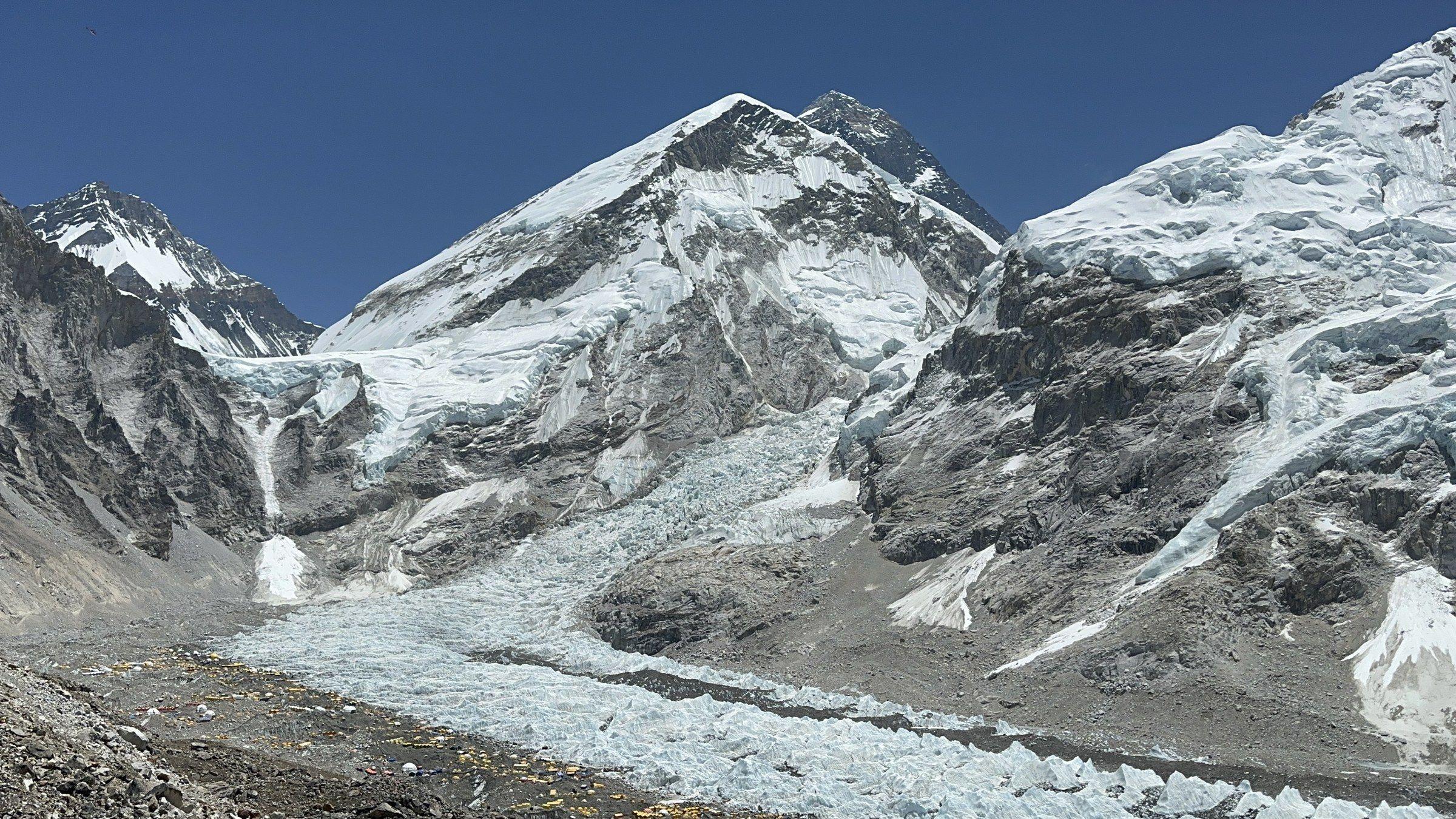
On 29 May 2026, Nepal Police runner Lakpa Ngima Sherpa ran the Tenzing Hillary Everest Marathon in 4:34:43. That is the fastest women's time in the race's official results. She finished seventh overall, and ahead of every foreign man in the field.
Follow @jurelimedia on Instagram.
A long way down from Base Camp
The race is held every 29 May, the anniversary of Tenzing Norgay Sherpa and Edmund Hillary's 1953 summit of Everest. It was first run in 2003. The full course is 42.195 kilometres, starting at Everest Base Camp, about 5,364 metres up, and finishing in Namche Bazaar. The official route descends through Gorak Shep and Dingboche, with a loop at Bibre, before the last drop into Namche.
The official results list 22 editions, from 2003 to 2019 and 2022 to 2026.
Seventh overall, and still ahead
She was not even the winner. Ramesh Limbu, also of Nepal, took the 2026 title in 3:35:59. Behind him came a string of Nepali men. Then came Lakpa, seventh of 218 finishers, in 4:34:43.
The first foreign man, Christian Hoffman of Austria, crossed the line ninth in 4:41:05. The eight runners in front of him were all Nepali, and one of them was the fastest woman the race has ever recorded.
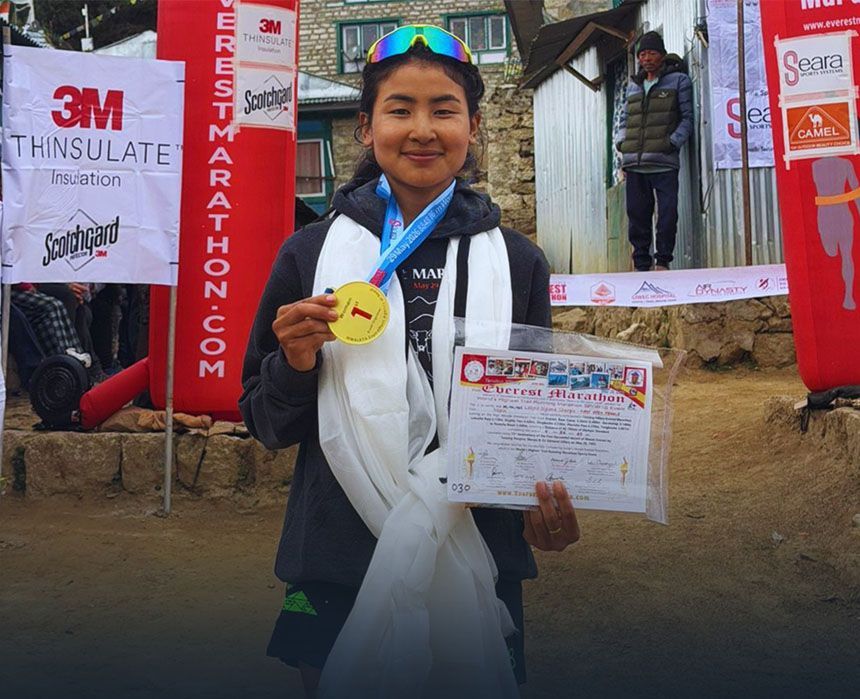 Lakpa Ngima Sherpa after the 2026 Tenzing Hillary Everest Marathon. Photo: Nepal Police Academy.
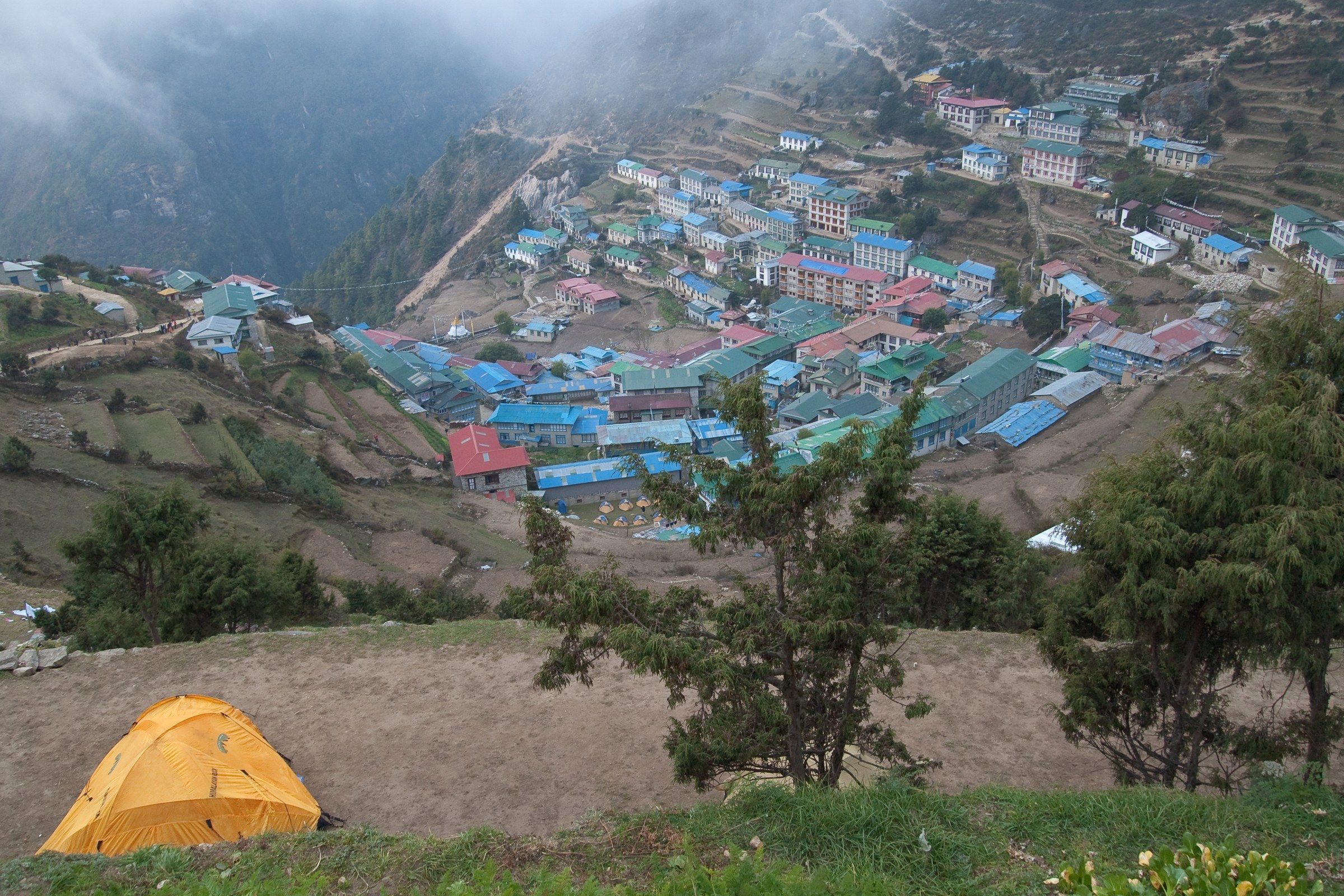 Namche Bazaar, where the marathon finishes. Photo: Vyacheslav Argenberg / Wikimedia Commons, CC BY 4.0

Twenty-two races, twenty-two Nepali winners
This was not a one-off. A Nepali runner has won every official edition of the full marathon. The course record is still 3:28:27, set in 2006 by Deepak Raj Rai, a farmer from Gudel in Solukhumbu. That year the first foreigner, Tom Perkins of the United Kingdom, finished 78th, in 6:01:24.
The fastest foreign time in the published results is still 4:24:02, run by Robert Celinski of Poland in 2016. Even the slowest Nepali winning time, 4:19:17 in 2005, is faster than that.
How hard is this, really?
Writer Michael Clinton, who ran the 2023 race, put it plainly in Men's Health. "My usual marathon time is around 4 hours 15 minutes, but for this one, I crossed the finish line at 12 hours and 30 minutes," he wrote. Then this, which we are quoting in full, as his account, not as a rule: "Most of the non-Nepali runners came in more than twice their usual marathon times or more, as well."
The thin air, the rocky trail and the long descent are a different kind of marathon. Foreign runners usually trek in for days to acclimatise. Many still find the day much slower than a road race at home.
Not more red blood cells
The usual guess is that highland runners simply have more red blood cells. Research on Tibetan and Sherpa highlanders points the other way. Variants in a gene called EPAS1, common in those groups, are linked to lower hemoglobin, not higher.
The edge appears to be blood flow. In one study, Tibetans living at 4,200 metres had more than twice the forearm blood flow of lowlanders at sea level, and more than ten times the circulating nitric oxide products that help blood vessels open. In another, at Everest Base Camp, Sherpas had up to 30 percent greater capillary density than lowlanders.
A note of care: those papers study Tibetan and Sherpa highlanders. Not every Nepali winner is Sherpa. The 2026 champion, Ramesh Limbu, is Limbu. Past winners have also included Kulung, Tamang, Gurung and others. The genetics help explain a highland advantage. They do not explain every name on the results sheet.
They grew up on these trails
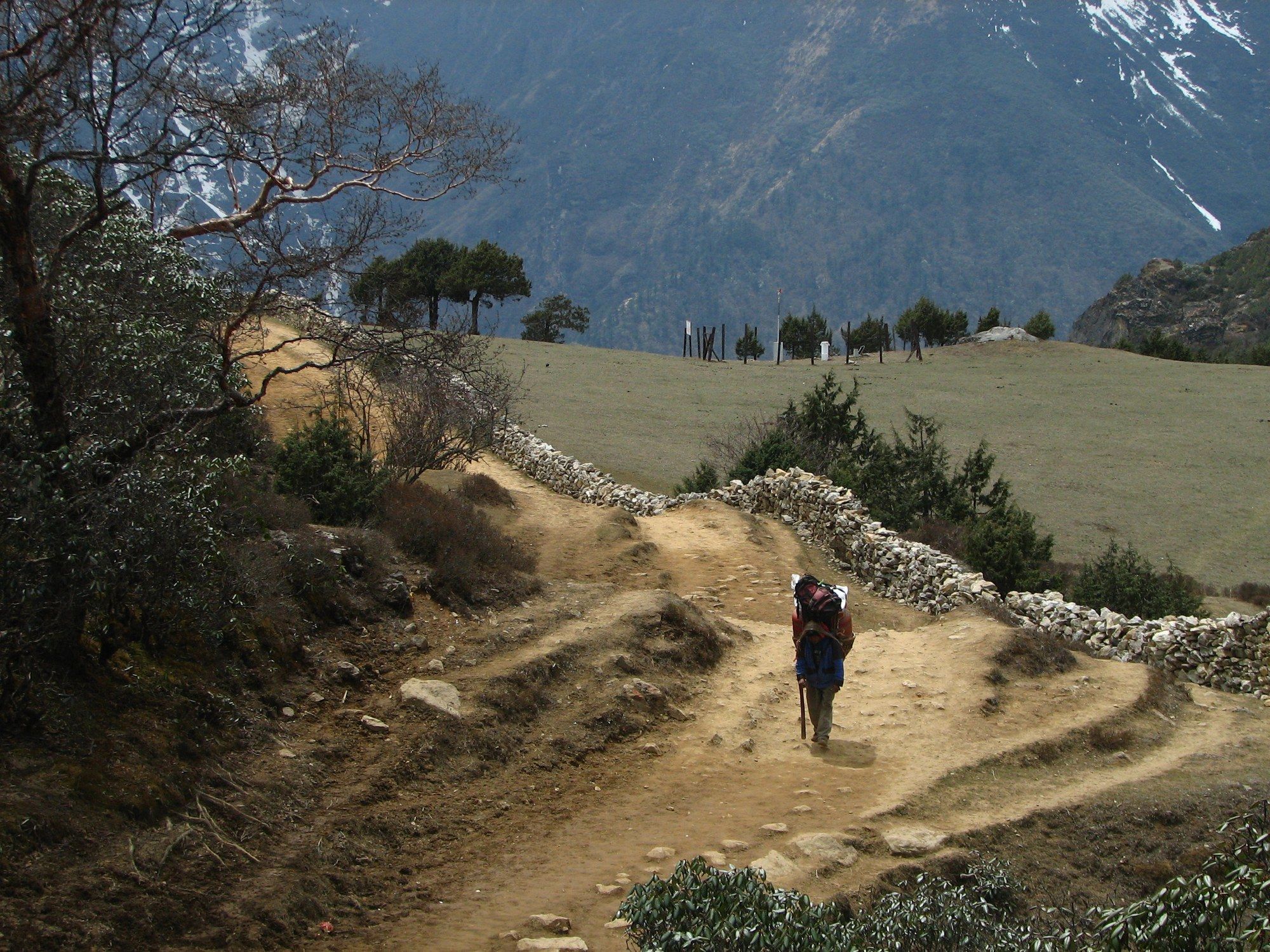 A porter on the trail above Namche Bazaar. Photo: McKay Savage / Wikimedia Commons, CC BY 2.0

There is also a simpler fact. Many of the fastest runners grew up walking these paths. Sudip Kulung, who won in 2011, grew up in Gudel, Solukhumbu. "I find it easy to run in the mountains but I can't run in the plains," he told Republica after that win.
So what would your marathon time be at Everest?
FAQ
Who won the 2026 Everest Marathon? Ramesh Limbu of Nepal won the full marathon in 3:35:59. Lakpa Ngima Sherpa was the first woman, in 4:34:43, and finished seventh overall.
Did a woman really beat every foreign man? Yes, in 2026. Lakpa's 4:34:43 was faster than the first foreign man, Christian Hoffman of Austria, who finished ninth in 4:41:05. She also finished ahead of every foreign man in 2024, in 4:42:00.
How long is the Tenzing Hillary Everest Marathon, and when is it held? The full course is 42.195 kilometres, from Everest Base Camp to Namche Bazaar. It is held every 29 May. The official results list 22 editions, from 2003 to 2019 and 2022 to 2026.
Has a foreign runner ever won? Not in the official full-marathon results. A Nepali runner has won all 22 listed editions. The fastest foreign time on those pages is Robert Celinski's 4:24:02 in 2016.
Where can I follow this story? On Instagram at @jurelimedia.
Photo credits
All photos used in this article are real photographs, cropped or resized only. None are AI-generated.
- Everest Base Camp (hero): DILARE POLAT, Wikimedia Commons, CC BY 4.0, taken 3 May 2024.
- Lakpa Ngima Sherpa at the 2026 finish: Photo: Nepal Police Academy.
- Namche Bazaar from above: Vyacheslav Argenberg, Wikimedia Commons, CC BY 4.0, taken 22 October 2009.
- Porter on the trail above Namche: McKay Savage, Wikimedia Commons, CC BY 2.0, taken 18 April 2007.

Sources
- Tenzing Hillary Everest Marathon, official 2026 results (Ramesh Limbu 3:35:59; Lakpa Ngima Sherpa 4:34:43, 7th, first woman; Christian Hoffman, Austria, 4:41:05, 9th, first foreign man; 218 full-marathon finishers).
- Official results for 2003–2019 and 2022–2025 (22 editions; a Nepali winner in each; 2003 and 2004 pages do not list nationality, but Uttar Kumar Rai, the 2003 winner, is listed as Nepal in the 2006 results, and Dangima Sherpa, the 2004 winner, is listed as Nepali as the 2005 winner).
- Official 2006 results (winner listed as Deepak Rai, 3:28:27; Tom Perkins, U.K., 6:01:24, 78th, first foreigner) and 2016 results (Robert Celinski, Poland, 4:24:02, first foreigner). Later official results (2007, 2008) and contemporary reporting name the 2006 record holder as Deepak Raj Rai.
- Official 2005 results (Dangima Sherpa, 4:19:17, the slowest winning time in the published results).
- Official 2024 results (Lakpa Ngima Sherpa, 4:42:00, also ahead of every foreign man that year) and 2011 results (Ang Futi Sherpa, 4:46:14, the previous published women's mark).
- Official full marathon and home pages (42.195 km, Everest Base Camp to Namche Bazaar via Gorak Shep, Dingboche and the Bibre loop; held on 29 May). The full-marathon page lists the start as 5,356 m; the organiser's lodge itinerary and INOV8 both give 5,364 m.
- "What It's Like To Run The Everest Marathon," INOV8, 4 June 2026 (start altitude 5,364 m; Limbu 3:35:59; Lakpa 4:34:43, first woman, seventh overall).
- Sagun S Lawoti, "Faster than the rest," Nepali Times, 2 June 2006 (Dipak Raj Rai, 3:28:27; a 24-year-old farmer from Gundel, Solukhumbu; start given as 5,364 m).
- "Nepali athletes dominate Everest Marathon, Kulung wins the title," Republica, 30 May 2011 (Sudip Kulung quote; race held since 29 May 2003; Deepak Raj Rai named as a three-time winner; Ang Futi Sherpa 4:46:14).
- "तेन्जिङ हिलारी एभरेष्ट म्याराथन २०२६ मा नेपाल प्रहरीका लाक्पा निमा शेर्पा प्रथम," Nepal Police Academy, 15 Jestha 2083 (Lakpa as a Nepal Police athlete; time 4:34:43). The page spells her name लाक्पा निमा; official results use Lakpa Ngima Sherpa.
- Michael Clinton, "The Grueling, Life-Changing Adventure of Running the Tenzing Hillary Everest Marathon," Men's Health, 14 June 2023.
- Cynthia M. Beall et al., "Natural selection on EPAS1 (HIF2α) associated with low hemoglobin concentration in Tibetan highlanders," Proceedings of the National Academy of Sciences, 2010.
- Masayuki Hanaoka et al., "Genetic Variants in EPAS1 Contribute to Adaptation to High-Altitude Hypoxia in Sherpas," PLoS ONE, 2012.
- S. C. Erzurum et al., "Higher blood flow and circulating NO products offset high-altitude hypoxia among Tibetans," Proceedings of the National Academy of Sciences, 2007.
- Edward Gilbert-Kawai et al., "Sublingual microcirculatory blood flow and vessel density in Sherpas at high altitude," Journal of Applied Physiology, 2017.