Nepali festivals
Dashain explained: a guide to Nepal’s major festival
Dashain is one of Nepal’s most widely observed festivals. For many families, it is a period of reunion, blessing, travel, food, new clothes, and visits across generations. Traditions vary by family, community, faith, and place.
- Often associated with
- Family reunions, blessings, tika, jamara, and travel
- Calendar
- Dates follow the lunar Nepali calendar and change in the Gregorian calendar
- Important note
- Rituals and observance differ across households and communities
What happens during Dashain?
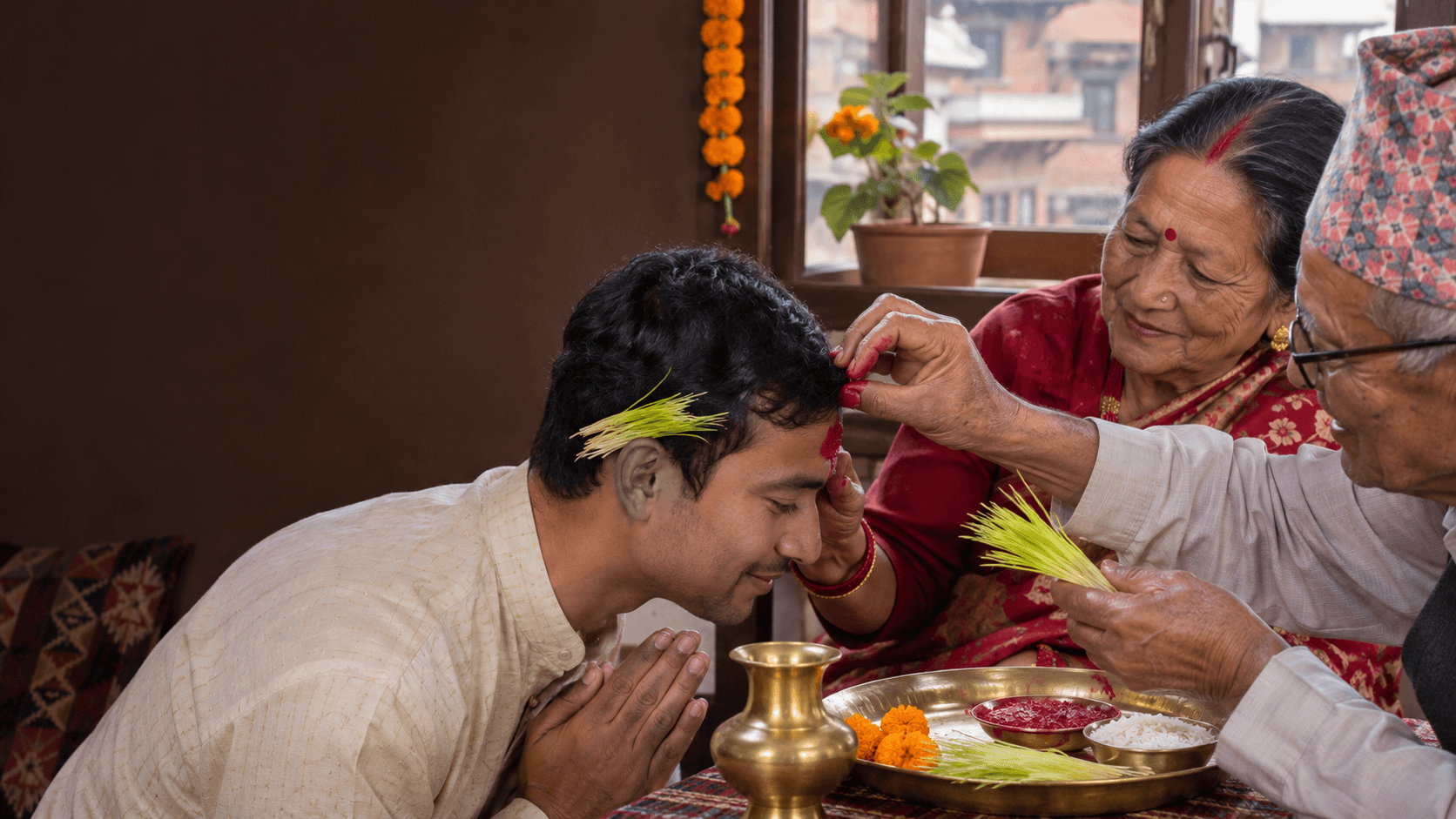
Dashain is observed across multiple days. Families clean and prepare their homes, travel to see relatives, and gather for meals. During the central tika observance, elders may place tika on younger relatives and offer blessings, often alongside jamara, sacred barley shoots.
The festival is commonly connected to the victory of good over evil in Hindu tradition. In lived practice, its meaning also comes from the time spent with family and the rhythms of travel, food, and homecoming.
Why dates can look different abroad
Dashain follows a lunar calendar, so the Gregorian dates change each year. For time-sensitive rites such as tika, communities may publish city-specific timings. A local observance should not be treated as a simple Nepal clock conversion.
If you are attending as a guest, ask your host what their family does. There is no need to perform a tradition you do not understand, and a respectful question is better than a guess.
Helpful language
A common greeting is 'Dashain ko subhakamana,' meaning best wishes for Dashain. The phrase is appropriate in messages, invitations, and greetings, while the specific rituals are personal to each family.
Quick answers
What are tika and jamara?
Tika is a colored mark placed on the forehead during a blessing. Jamara are barley shoots grown for the festival and commonly offered with the blessing. Practices and materials can vary by family.
Is Dashain observed the same way by every Nepali family?
No. Nepal is culturally and religiously diverse. Some families observe the festival closely, some selectively, and others do not observe it at all.
Keep exploring
Find the people carrying culture forward.
JureliHub connects cultural context with Nepali creators and diaspora communities.
Explore creator hubs