Nepali festivals
Dashain tika explained: sait, timing, and family blessings
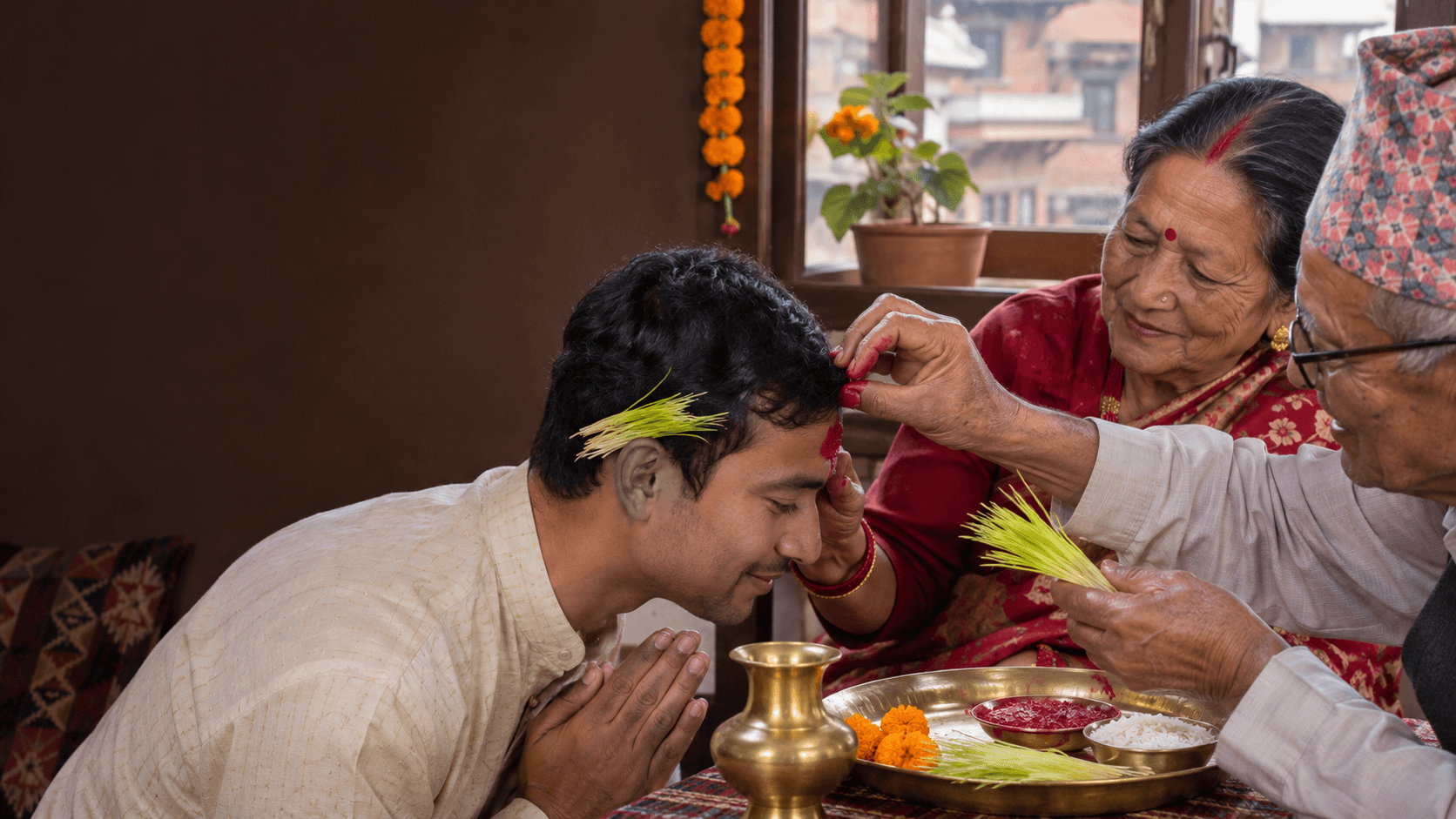
Dashain tika is a family blessing most closely associated with Vijaya Dashami. Elders may place tika on younger relatives, offer jamara, and give blessings for wellbeing, learning, and prosperity. The exact practice is personal: families differ in who gives tika, what they use, and how they gather.
- Usually observed on
- Vijaya Dashami during the Dashain festival
- Sait
- An auspicious time published for a specific year and place
- Important context
- Family practice and local timing can vary
What is Dashain tika?
Tika is the colored mark placed on the forehead as part of a blessing. During Dashain, it is often given with jamara, sacred barley shoots, and a blessing from an elder to a younger family member. Gifts, food, visits, and travel often surround the moment.
There is no single household script. Some families gather at a grandparent’s home, some visit across several days, and others adapt the tradition around work, school, distance, or different family beliefs.
What does “Dashain tika sait” mean?
Sait refers to an auspicious time used for the central Dashain tika observance. It is not simply the time in Nepal converted into another time zone. Annual calendars and Panchanga calculations can publish different local times for Kathmandu, the United States, the United Kingdom, Australia, and other places.
For a current-year tika time, use an announcement that clearly names both the year and the city or country. A prior year’s time should not be reused, and an unsourced social post is not a reliable substitute for a local calendar or community notice.
If a family cannot gather at the exact sait
Many diaspora families need to work around travel, work, school, and time zones. The auspicious moment matters to people who follow it, while family blessings and visits may continue after that moment according to household practice. When joining another family, the respectful move is simply to ask what they do.
Jureli publishes date- and city-specific Dashain timing only after it is confirmed for that year. This guide is the evergreen context behind those annual updates.
Quick answers
What time is Dashain tika this year?
The time changes each year and can differ by location. Use a current-year notice that names your city or country rather than converting a Kathmandu time or reusing an old timetable.
Is Dashain tika only at the exact sait?
The sait is the designated auspicious moment for families who follow it. How families continue blessings and visits afterwards varies, especially across the diaspora.
What are tika and jamara?
Tika is a colored mark placed on the forehead during a blessing. Jamara are barley shoots grown for Dashain and commonly offered with the blessing.
Keep exploring
Find the people carrying culture forward.
JureliHub connects cultural context with Nepali creators and diaspora communities.
Explore creator hubs